Arham Cutlery
Walnut Ravenlong™ Historical Seax – Carbon Steel & Walnut Handle
Walnut Ravenlong™ Historical Seax – Carbon Steel & Walnut Handle
Shipped from USA
- 30 DAYS RETURN
- Handmade
- Fast & Free Shipping
No se pudo cargar la disponibilidad de retiro
The Walnut Ravenlong™ Historical Seax is a long, historically inspired seax featuring an 18.3-inch 1040 carbon steel blade, broken-back profile, natural walnut handle, brass fittings, and a hand-stitched leather scabbard.
At approximately 23 inches overall, its extended proportions create a distinctive interpretation of the long single-edged seax forms associated with Northern European history during the Early Middle Ages.
Details
The Walnut Ravenlong™ measures approximately 23 inches overall and features an 18.3-inch blade with a width of approximately 1.5 inches.
Its single-edged blade is made from 1040 carbon steel and specified at approximately 58–60 HRC. The broken-back profile creates an angular transition along the spine toward the point, giving this Historical Seax a noticeably different silhouette from straight-back designs.
A natural walnut handle is complemented by brass caps, brass accents, and a double bolster.
For another long broken-back design, compare it with the Ravenback Longcrest™ Long Seax.
Blade
The blade measures approximately 18.3 inches long and 1.5 inches wide.
It is made from 1040 carbon steel and comes with a sharpened edge. Its long proportions and broken-back geometry create the characteristic profile that distinguishes this design from shorter and straighter seax forms.
The seax historically existed as both a tool and a blade in various forms, with archaeological examples differing considerably by period, region, dimensions, and construction.
Broken-Back Profile
One of the defining visual characteristics of the Walnut Ravenlong™ is its broken-back blade profile.
Rather than maintaining a continuous straight spine toward the point, the upper line changes direction near the forward section of the blade. This creates the angular silhouette commonly associated with broken-back seax designs.
To compare this profile with a straight-back example, explore the Gotland Bonecrest™ Gotland Seax.
Historical Seax Inspiration
Historical seaxes appeared across Germanic and Northern European cultures in numerous sizes and configurations.
Examples associated with the Early Middle Ages demonstrate that the seax was not one standardized design. Blade lengths, widths, profiles, handles, and fittings varied considerably across regions and periods.
The Walnut Ravenlong™ is a modern historically inspired design rather than an exact reproduction of one particular archaeological artifact. This distinction is important when describing any historic seax based on traditional forms.
Walnut Handle & Brass Fittings
Natural walnut gives the handle visible grain and warm coloration.
Brass caps and accents provide contrast, while the double bolster adds another traditional-looking detail to the handle assembly.
Because walnut is a natural material, individual pieces can vary slightly in grain pattern, shade, and markings.
Leather Scabbard
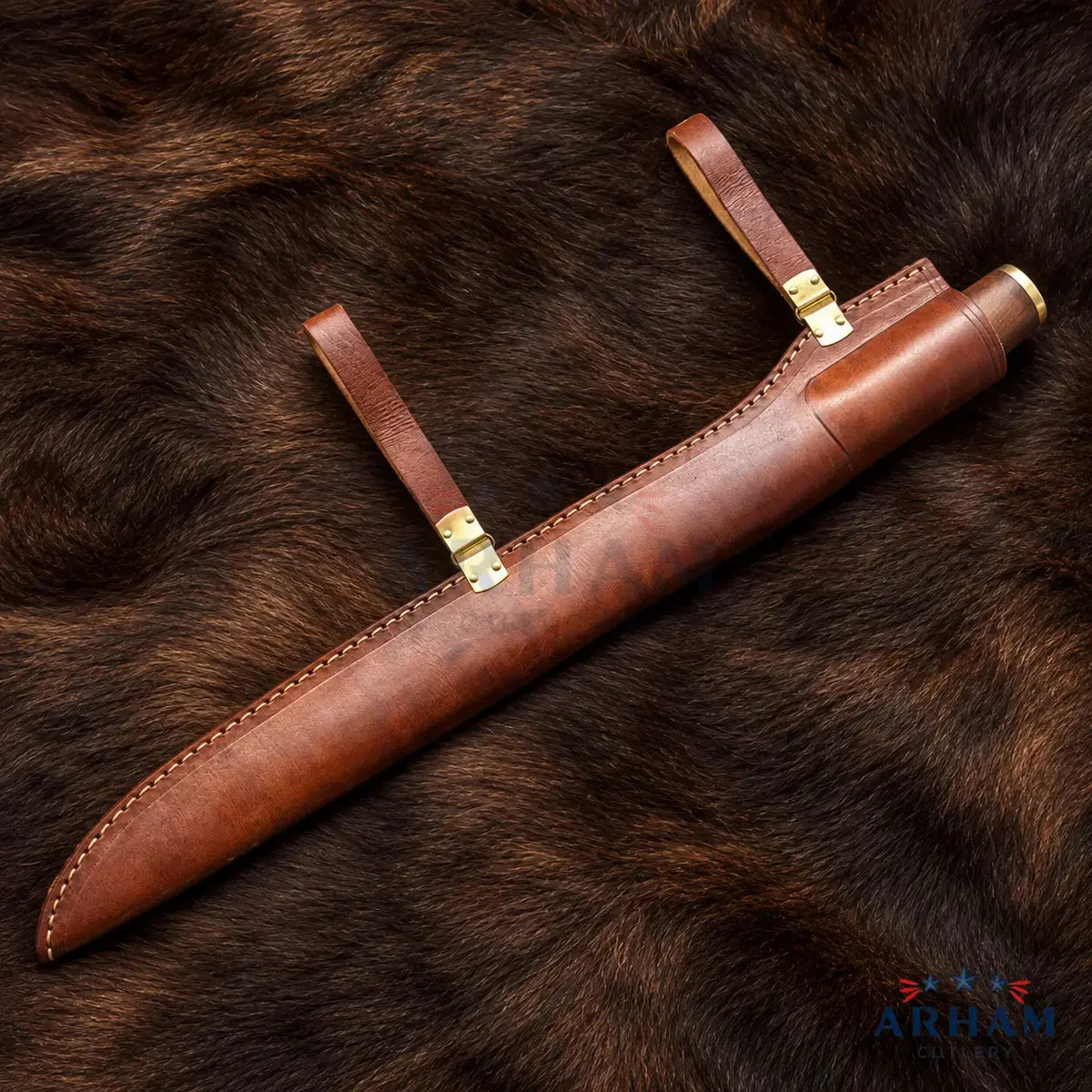
A hand-stitched leather scabbard is included with the Walnut Ravenlong™.
The scabbard provides safe storage and carrying when used appropriately. Before placing the blade inside, make sure it is clean and completely dry.
Because leather can retain moisture, avoid leaving a damp blade inside the scabbard, particularly during extended storage.
Care & Use
Carbon steel requires routine care to help prevent oxidation. After handling or use, clean the blade when necessary and dry it completely. Remove fingerprints and moisture before applying a thin coating of suitable knife-safe oil.
Never place a wet blade inside the leather scabbard. During longer storage periods, inspect the blade periodically and renew its protective coating when necessary.
The natural walnut handle should be kept away from prolonged soaking, excessive heat, and harsh household cleaning chemicals.
Specifications
Product Name: Walnut Ravenlong™
Style: Historical Seax
Overall Length: Approx. 23 in
Blade Length: Approx. 18.3 in
Blade Width: Approx. 1.5 in
Blade Steel: 1040 Carbon Steel
Hardness: Approx. 58–60 HRC
Blade Profile: Broken Back
Edge: Sharpened
Handle Material: Walnut Wood
Fittings: Brass Caps & Accents
Bolster: Double Bolster
Scabbard: Hand-Stitched Leather Scabbard
Design: Historically Inspired Seax
Frequently Asked Questions
What is a historical seax knife?
A historical seax refers to the family of single-edged blades associated with Germanic and Northern European peoples across different historical periods. Surviving examples vary significantly in blade length, profile, handle construction, and fittings.
How do I pronounce seax?
“Seax” is commonly pronounced approximately like the English word “sax.”
What did a Saxon seax look like?
There was no single universal Saxon seax design. Historical examples ranged from relatively compact blades to substantially longer forms and included variations in blade width, spine geometry, handles, and fittings.
When did the seax stop being used?
Seaxes changed considerably across different periods and regions, so there is no single date when every form disappeared. Their prevalence declined as other blade forms became more dominant during the medieval period.
Is the Walnut Ravenlong™ an exact archaeological reproduction?
No. It is a historically inspired seax based on traditional design characteristics rather than an exact reproduction of one specific archaeological artifact.
Share